Showing posts with label Nanotech. Show all posts

Saturday, November 22, 2008

FUN FACTS: EXACTLY HOW SMALL (AND POWERFUL) IS 45 NANOMETERS?

  • There are 1 billion nanometers (nm) in one meter. A meter is approximately 3 feet.
  • The original transistor built by Bell Labs in 1947 could be held in your hand, while hundreds of Intel’s new 45nm transistors can fit on the surface of a single red blood cell.
  • If a house shrunk at the same pace transistors have, you would not be able to see a house without a microscope. To see the 45nm transistor, you need a very advanced microscope.
  • The price of a transistor in one of Intel’s forthcoming next-generation processors -- codenamed Penryn -- will be about 1 millionth the average price of a transistor in 1968. If car prices had fallen at the same rate, a new car today would cost about 1 cent.
45nm Size Comparison

o A nail = 20 million nm
o A human hair = 90,000nm
o Ragweed pollen = 20,000nm
o Bacteria = 2,000nm
o Intel 45nm transistor = 45nm
o Rhinovirus = 20nm
o Silicon atom = 0.24nm

  • You could fit more than 2,000 45nm transistor gates across the width of a human hair.
  • You could fit more than 30 million 45nm transistors onto the head of a pin, which measures approximately 1.5 million nm (1.5 mm) in diameter.
  • More than 2 million 45nm transistors could fit on the period at the end of this sentence (estimated to be 1/10 square millimeter in area).
  • A 45nm transistor can switch on and off approximately 300 billion times a second. A beam of light travels less than a tenth of an inch during the time it takes a 45nm transistor to switch on and off.

World's First 2-Billion Transistor Microprocessor


Breaking the performance barrier

Next-generation Intel® Itanium® processors (codenamed Tukwila) take the next big leap in processor-based server technology. As the world's first 2-billion transistor microprocessor, Tukwila is designed to provide highly scalable and reliable performance for mission-critical enterprise server solutions.

With Tukwila, you can experience these benefits and more:

  • Achieve more than double the performance with next-generation quad-core technology²
  • Get outstanding levels of system integration with 30MB total on-die cache providing improved performance for data-intensive, mission-critical solutions
  • Maximize energy efficiency and performance-per-watt with the advanced power/ thermal design features built into Tukwila
  • Get leading-edge reliability, availability, and serviceability (RAS) and scalable performance with the high-speed interconnect technology enabled by Intel® QuickPath architecture and memory RAS features

Delivering unmatched scalable performance, Tukwila is optimized for the intensive requirements of database, enterprise resource planning (ERP), and business intelligent (BI) applications. As a standards-based replacement for RISC, Tukwila-based servers are the answer to the increasing scalable needs of the global enterprise providing unmatched flexibility and headroom for the future.

Tukwila is targeted for production towards the end of 2008.

Sunday, November 16, 2008

Nanorobotics


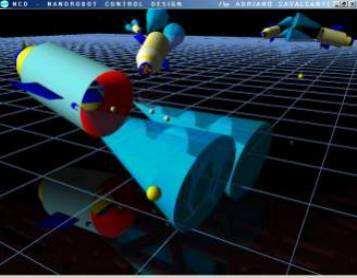
Nanorobotics is the technology of creating machines or robots at or close to the microscopic scale of a nanometre (10-9 metres). More specifically, nanorobotics refers to the still largely hypothetical nanotechnology engineering discipline of designing and building nanorobots. Nanorobots (nanobots, nanoids, nanites or nanonites) would be typically devices ranging in size from 0.1-10 micrometers and constructed of nanoscale or molecular components. As no artificial non-biological nanorobots have yet been created, they remain a hypothetical concept.

Another definition sometimes used is a robot which allows precision interactions with nanoscale objects, or can manipulate with nanoscale resolution. Following this definition even a large apparatus such as an atomic force microscope can be considered a nanorobotic instrument when configured to perform nanomanipulation. Also macroscale robots or microrobots which can move with nanoscale precision can also be considered nanorobots.

Nanomachines are largely in the research-and-development phase, but some primitive molecular machines have been tested. An example is a sensor having a switch approximately 1.5 nanometers across, capable of counting specific molecules in a chemical sample. The first useful applications of nanomachines, if such are ever built, might be in medical technology, where they might be used to identify cancer cells and destroy them. Another potential application is the detection of toxic chemicals, and the measurement of their concentrations, in the environment. Recently, Rice University has demonstrated a single-molecule car which is developed by a chemical process and includes buckyballs for wheels. It is actuated by controlling the environmental temperature and by positioning a scanning tunneling


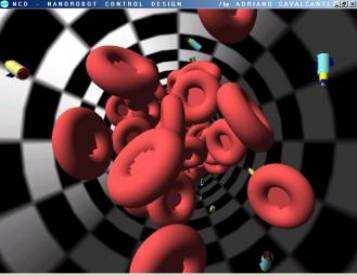
Initial uses of nanorobots to health care are likely to emerge within the next ten years with potentially broad biomedical applications. The ongoing developments of molecular-scale electronics, sensors and motors are expected to enable microscopic robots with dimensions comparable to bacteria. Recent developments on the field of biomolecular computing has demonstrated positively the feasibility of processing logic tasks by bio-computers, which is a promising first step to enable future nanoprocessors with increasingly complexity. Studies in the sense of building biosensors and nano-kinetic devices, which is required to enable nanorobots operation and locomotion, has been advanced recently too. Moreover, classical objections related to the real feasibility of nanotechnology, such as quantum mechanics, thermal motions and friction, has been considered and resolved and discussions about the manufacturing of nanodevises is growing up. Developing nanoscale robots presents difficult fabrication and control challenges. The control design and the development of complex integrated nanosystems with high performance can be well analysed and addressed via simulation to help pave the way for future use of nanorobots in biomedical engineering problems.