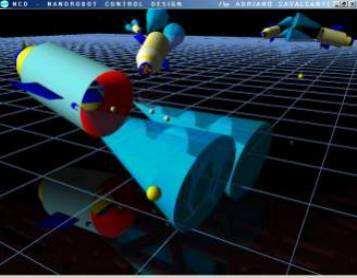
Nanorobotics is the technology of creating machines or robots at or close to the microscopic scale of a nanometre (10-9 metres). More specifically, nanorobotics refers to the still largely hypothetical nanotechnology engineering discipline of designing and building nanorobots. Nanorobots (nanobots, nanoids, nanites or nanonites) would be typically devices ranging in size from 0.1-10 micrometers and constructed of nanoscale or molecular components. As no artificial non-biological nanorobots have yet been created, they remain a hypothetical concept.
Another definition sometimes used is a robot which allows precision interactions with nanoscale objects, or can manipulate with nanoscale resolution. Following this definition even a large apparatus such as an atomic force microscope can be considered a nanorobotic instrument when configured to perform nanomanipulation. Also macroscale robots or microrobots which can move with nanoscale precision can also be considered nanorobots.
Nanomachines are largely in the research-and-development phase, but some primitive molecular machines have been tested. An example is a sensor having a switch approximately 1.5 nanometers across, capable of counting specific molecules in a chemical sample. The first useful applications of nanomachines, if such are ever built, might be in medical technology, where they might be used to identify cancer cells and destroy them. Another potential application is the detection of toxic chemicals, and the measurement of their concentrations, in the environment. Recently, Rice University has demonstrated a single-molecule car which is developed by a chemical process and includes buckyballs for wheels. It is actuated by controlling the environmental temperature and by positioning a scanning tunneling

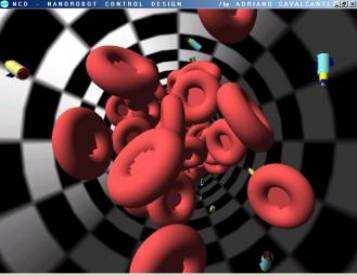
Initial uses of nanorobots to health care are likely to emerge within the next ten years with potentially broad biomedical applications. The ongoing developments of molecular-scale electronics, sensors and motors are expected to enable microscopic robots with dimensions comparable to bacteria. Recent developments on the field of biomolecular computing has demonstrated positively the feasibility of processing logic tasks by bio-computers, which is a promising first step to enable future nanoprocessors with increasingly complexity. Studies in the sense of building biosensors and nano-kinetic devices, which is required to enable nanorobots operation and locomotion, has been advanced recently too. Moreover, classical objections related to the real feasibility of nanotechnology, such as quantum mechanics, thermal motions and friction, has been considered and resolved and discussions about the manufacturing of nanodevises is growing up. Developing nanoscale robots presents difficult fabrication and control challenges. The control design and the development of complex integrated nanosystems with high performance can be well analysed and addressed via simulation to help pave the way for future use of nanorobots in biomedical engineering problems.

No comments:
Post a Comment